Electricity and Energy Minister Kgosientsho Ramokgopa unveiled the investment drive during a visit to China, where he sought financing, technology and industrial partnerships to accelerate South Africa’s energy transition while expanding domestic manufacturing capacity.
Chinese officials expressed support for the country’s power expansion plans.
Rather than seeking capital alone, Pretoria is encouraging Chinese companies to establish manufacturing operations in South Africa to produce critical energy equipment including transformers, batteries, solar components, cables and other grid infrastructure.
The government says local production would reduce import dependence, strengthen industrial capacity and create jobs while supporting one of the continent’s largest electricity expansion programmes.
Speaking during engagements with Chinese investors, Ramokgopa said South Africa offers one of Africa’s biggest long-term energy investment opportunities, underpinned by policy reforms and improving electricity reliability.
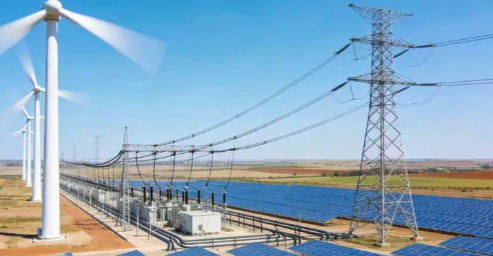
The investment pipeline covers about 105 gigawatts of new electricity generation alongside a major expansion of transmission infrastructure through 2039, including roughly 14,500 kilometres of new power lines designed to connect renewable energy projects and growing industrial demand.
Moving beyond the power crisis
The investment push represents a significant shift in South Africa’s energy strategy.
For years, rolling power cuts, known locally as load shedding, disrupted factories, mines and businesses, weighing heavily on Africa’s largest industrial economy and limiting economic growth.
As electricity supply has improved, the government’s focus has increasingly shifted from emergency interventions to building long-term infrastructure capable of supporting industrial expansion and the clean-energy transition.
Why China matters
China dominates global manufacturing of solar panels, batteries, transmission equipment and many other clean-energy technologies, making it an important partner for countries seeking to modernise their electricity systems.
By encouraging Chinese firms to manufacture equipment locally instead of relying solely on imports, South Africa hopes to capture more value from the energy transition while creating skilled industrial jobs.
The approach also aligns with Pretoria’s broader industrial policy of strengthening domestic production and integrating local manufacturers into global clean-energy supply chains.
Source: Africabusinessinsider