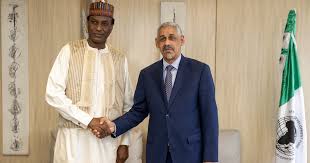
The new financing marks a major step in Niger’s collaboration with the African Development Bank to accelerate national electrification and promote private-sector-led growth.
The agreement, signed at the AfDB headquarters in Abidjan, provides budgetary support through the African Development Fund, the Bank’s concessional financing arm.
It will fund the first phase of the Energy Sector Governance and Competitiveness Support Programme (PAGSEC), a flagship initiative aimed at modernising Niger’s energy sector and boosting economic resilience.
Speaking at the signing ceremony, Prime Minister Ali Mahamane Lamine Zeine described the agreement as a major step in Niger’s partnership with the Bank.
“It is with great pleasure that we have just formalised this agreement, which is very important for Niger,” he said. “The agreement is part of our strong cooperation with the African Development Bank Group.” He said.
Prime Minister Zeine, who also serves as Niger’s Minister of Economy and Finance and Governor of the AfDB for Niger, added that the programme would play a vital role in improving competitiveness and economic stability.
Under the PAGSEC programme, Niger aims to increase national electricity access from 22.5% to 30% by 2026, while raising the manufacturing sector’s contribution to GDP from 2.5% to 3.8%.
A major component of the programme focuses on renewable energy development, with plans to install 240 megawatts (MW) of solar capacity by 2030, including 50 MW by December 2026.
Despite ongoing security and climate-related challenges, Niger remains one of the fastest-growing economies in the Sahel. The government is working to diversify growth beyond agriculture, mining, and remittances by adding value to its uranium, gold, and oil resources and investing in renewable energy to power local industries.
The programme supports this diversification agenda by improving governance, enhancing tax mobilisation, and attracting private investment into the energy and manufacturing sectors.
The programme places strong emphasis on social inclusion, targeting women, youth, and more than 507,000 internally displaced persons affected by insecurity in the Sahel. It also seeks to update national energy policies and establish high-level coordination mechanisms to foster private investment in renewable energy infrastructure.
Source: Africabusinessinsider