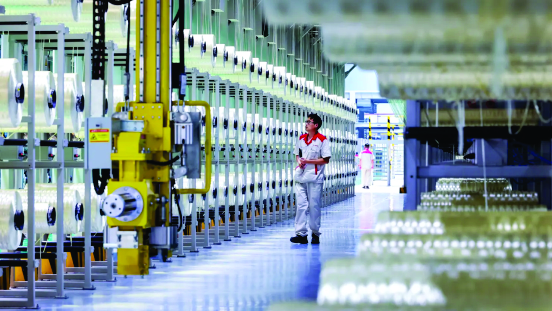
China’s manufacturing activity expanded faster than expected in June, with high-tech production climbing on demand tied to the global artificial-intelligence investment boom while real estate development and consumer goods production remained under pressure.
The official purchasing managers’ index edged up to 50.3 in June from 50.0 in May, beating economists’ forecast of 50.1 and returning to expansionary territory above the 50-mark threshold.
Supply and demand both improved in June, according to the National Bureau of Statistics, as the sub-indexes for production and new orders picked up to 51.4 and 51.2, respectively. New export orders rebounded to 50.1 in June, signaling a recovery in overseas demand as easing tensions in the Middle East reduced fears of a severe energy and growth shock.
High-tech equipment manufacturing outpaced the broader factory sector, with its PMI climbing to 53.5 in June on stronger advanced manufacturing output, while consumer goods production lagged at 50.2.
External demand and AI-related tech demand were the main engines of China’s growth momentum in June, said Julian Evans-Pritchard, head of China economics at Capital Economics, while “real estate services were still struggling.”
The non-manufacturing gauge, which tracks construction and services activity, rose to 50.2 from 50.1 in May, according to data by the statistics agency. Construction’s business activity index continued to contract in June, edging up 0.2 percentage points to 49.0 from the prior month.
Exports remained a bright spot with U.S. importers rushing to bring forward shipments after President Donald Trump’s meeting with Chinese leader Xi Jinping in May set relations on a steady footing. The frontloading also came ahead of the expiry of a 10% levy under Section 122 in July.
The U.S. has yet to impose additional duties that could emerge from Washington’s Section 301 probes targeting countries identified for overcapacity and forced labor practices.
Separate data released Saturday showed industrial profits in upstream sectors, as well as in AI- and renewable-energy-related industries, posting sharp gains, while downstream manufacturers remained under pressure amid weak domestic demand.
China’s retail sales fell in May for the first time in more than three years, and new home prices declined at a faster pace, underscoring the drag from a prolonged property downturn.
The RatingDog manufacturing PMI, a private survey that tends to capture smaller and more export-oriented firms, is expected to fall to 51.6 from 51.8 in May, when results are released Wednesday. The gauge has historically run above the official PMI reading, in part reflecting the country’s export strength.
“The hope of rebalancing is dashed,” said Helen Qiao, China economist at Bank of America Global Research, citing stronger exports and weaker domestic demand. The bank upgraded its forecast for China’s export growth this year to 15%, citing strong AI-related investment, global demand for renewable energy equipment and electric vehicles.
Source: cnbc