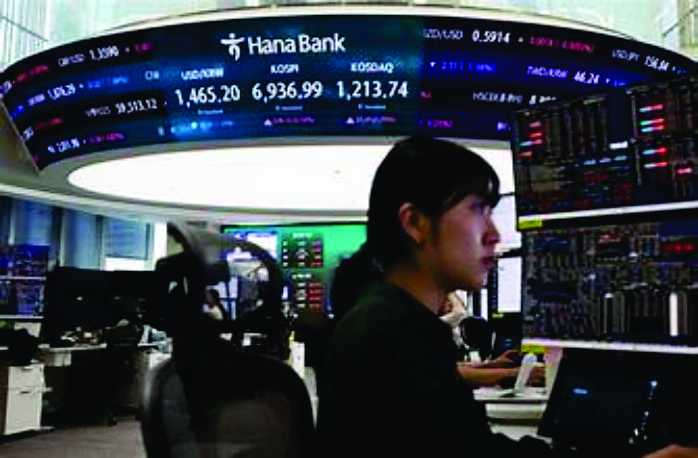
The “sell in May and go away” strategy does not appear to be working in Seoul this year, as the benchmark Kospi continues its record-setting rally, breaking above 6,900 points on Monday to near the 7,000 milestone, led by a more than 10 percent surge in chip giant SK hynix.
“Sell in May and go away” is a market adage suggesting investors exit stocks in May to avoid historically weaker returns through October. But the Kospi set a fresh record on the first trading day in May, rising as much as 5.12 percent to close at 6,936.99 on Monday. Some analysts project the index could top 7,500 by the end of next month.
Monday’s jump was driven by strong foreign buying in chipmakers, following higher-than-expected earnings of U.S. tech firms and as investors awaited developments in U.S.-Iran peace talks. Foreigners net bought 3.9 trillion won ($2.67 billion) worth of local shares, and institutions purchased a net 2.56 trillion won, while retail investors dumped a net 6.34 trillion won. The tech-heavy Kosdaq also closed up 1.79 percent to 1,213.74.
SK hynix, the country’s major memory chip producer, led the sharp rally, surging 12.52 percent to a record high of 1.45 million won. Its market capitalization surpassed 1 quadrillion won for the first time, narrowing the gap with chip rival Samsung Electronics’ 1.36 quadrillion won valuation, as Samsung shares rose 5.44 percent on the same day to 232,500 won. SK Square, which owns 20 percent of SK hynix, soared 17.84 percent to 991,000 won.
“After Big Tech earnings, expectations for AI capex continued to build,” said Kang Jin-hyeok, a market analyst at Shinhan Securities. “Strong results from Apple also fueled risk-on sentiment, driving U.S. markets to fresh record highs.”
The S&P 500 and Nasdaq reached record highs following Apple’s earnings report on Thursday, which saw 17 percent revenue growth in the second fiscal quarter that ended, in March, topping estimates.
Experts say the strength of the semiconductor sector could soon propel the Kospi to 7,500 points in the first half of the year, calling it a “valuation normalization based on earnings,” according to Lee Kyoung-min, a strategist at Daishin Securities.
Other potential triggers include SK hynix’s planned U.S. listing in the second half of the year through American depositary receipts (ADRs), a mechanism that allows foreign companies’ shares to trade on U.S. exchanges or over-the-counter in dollar-denominated form. The debut of single-stock leveraged exchange-traded funds (ETFs), set to begin trading as early as May 22, is also expected to boost trading volumes in chipmakers.
“The average export price of semiconductors in April rose 29 percent compared to the first-quarter average, a level that meets or exceeds revised earnings forecasts for the sector for the remainder of the year upwardly,” said Yang Il-woo, an analyst at Samsung Securities. “Given that rising end demand for semiconductors is being driven by AI, chip prices are likely to decline more slowly and by a smaller margin than in past cycles.”
Defense shares were also strong as industry leader Hanwha Aerospace advanced 3.39 percent to 1.47 million won, and LIG D&A gained 4.46 percent to 983,000 won. Carmaker Hyundai Motor gained 1.51 percent to 539,000 while Kia rose 1.45 percent to 154,000 won. Celltrion decelerated 1.35 percent to 197,800 won while Hanmi Pharmaceutical lost 3.26 percent to 445,000 won. Samsung Biologics rose 1.02 percent to 1.49 million won.
Amid the steep rally, global investment banks have raised their forecasts for the Kospi in April, with JPMorgan lifting its 12-month target to 8,500 under a bull-case scenario. Goldman Sachs, meanwhile, raised its target to 8,000, citing the index’s 12-month forward price-to-earnings ratio of around 7.5x — well below the historical mid-cycle peak multiple of 10x. The Korean won traded at 1,462.8 won against the U.S. dollar at 3:30 p.m., up 20.5 won from the previous session.
Source: Koreajoongangdaily