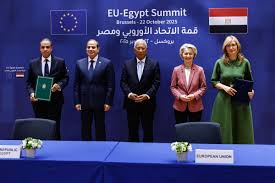
Egypt’s President Abdel Fattah El Sisi and top European Union officials made significant progress in Egypt-EU relations during the first Egypt–European Union Summit in Brussels. At the event, the EU committed EUR4 billion ($4.6 billion) to support Egypt’s economy, and the two sides confirmed that the next summit will take place in Cairo in 2027. This summit solidifies an increasingly strategic partnership aimed at fostering economic growth, political cooperation, regional stability, and shared values between Egypt and the EU.
At the heart of the summit’s announcements was the signing of a fresh EUR4 billion agreement to support Egypt’s economy. European Commission President Ursula von der Leyen hailed the deal as a “crucial step toward creating a more attractive business environment and drawing greater investment to Egypt.” She emphasized that this milestone represents “excellent news for Egypt’s economic potential and future growth,” underscoring the intention to deepen cooperation with Egypt as a key regional partner.
This latest funding forms part of a broader EUR7.4 billion package covering 2024 to 2027, conceived to sustain Egypt’s economic recovery and long-term development. The foundation of this expanded cooperation dates back to a Strategic and Comprehensive Partnership signed in Cairo in March 2024. This framework rests on six fundamental pillars: political relations, economic stability, trade and investment, migration and mobility, security, and human capital. Together, these pillars aim to create a holistic partnership that addresses the wide-ranging challenges and opportunities of shared interest.
The agreements signed during the summit are aimed at broadening collaboration across key sectors while reinforcing a collective commitment to peace, security, democratic governance, the rule of law, and respect for human rights and fundamental freedoms. In Brussels, a significant advance was formalizing Egypt’s participation in Horizon Europe — the EU’s premier research and innovation program. This inclusion will enable Egyptian researchers and institutions to lead projects, thereby strengthening national research capabilities and fostering innovation.
Migration governance—a critical issue for both Egypt and Europe—also featured prominently in the discussions. Both parties reaffirmed their commitment to a comprehensive approach that focuses on “structured, fair and regular migration pathways” alongside continued collaboration in border management, search and rescue operations, and combating migrant smuggling. These cooperative efforts aim to establish sustainable and humane migration management in a region often challenged by complex migratory flows.
Source: Economymiddleeast